

Gauthier, P. A., Evans, S., Guido, V., Brathwaite, A. C., Versailles, D., Juüdi-Hope, D. A., Garraway, C., Costa, T., Suva, G., Stade, B., & Grinspun, D. (2024). Health equity consortium: Equity, diversity, and inclusion for black, indigenous, and 2SLGBTQIA+ nurses. Canadian Journal of Nursing Research, December 16, on-line. https://doi.org/10.1177/08445621241299999
Abstract
This article provides reflections on the initiatives and experiences of nurses who identify as Black, Indigenous, and/or 2SLGBTQIA + within the Canadian healthcare system, as well as the efforts of the Health Equity Consortium to promote equity within the nursing profession. The paper explores the unwavering commitment of marginalized nurses to exceptional patient care despite facing pervasive prejudices and discrimination. It discusses the Registered Nurses’ Association of Ontario's (RNAO) commitment to diversity and the creation of the Health Equity Consortium to address systemic barriers. Furthermore, the article highlights the concept of intersectional stigma and the need for comprehensive cultural competency training and inclusive leadership practices. Additionally, it outlines the consortium's aim to gather more information and publish further work to advance equity within the nursing profession and healthcare system. Ultimately, the reflection underscores the importance of collective action and ongoing dialogue to drive meaningful change towards a more equitable and inclusive healthcare system.
Article published. December 16, 2024
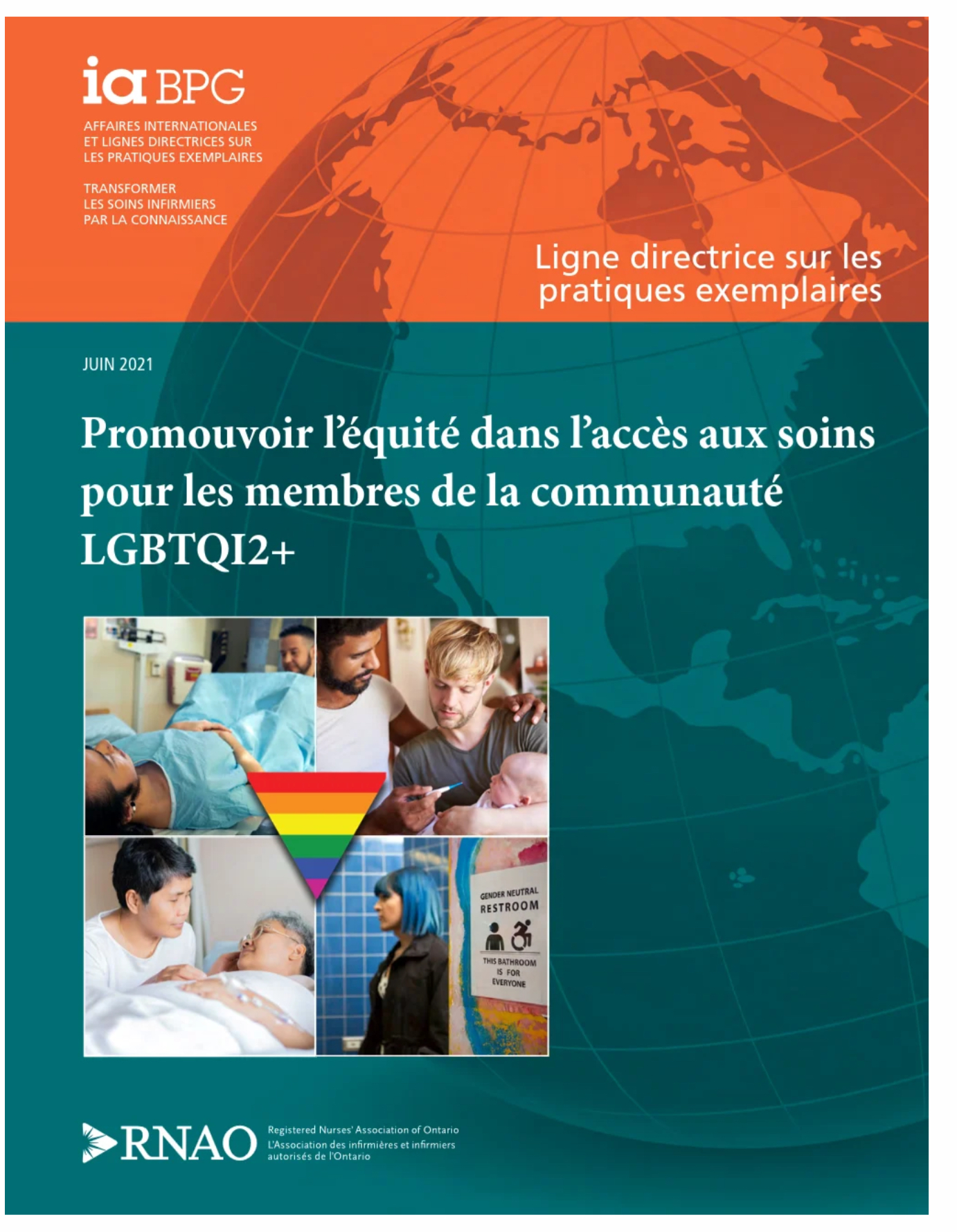
Promouvoir l’équité dans l’accès aux soins pour les membres de la communauté LGBTQI2+. En français- ici
Ce nouveau guide de bonnes pratiques (GBP) s’intitule « Promouvoir l’équité en santé des personnes 2SLGBTQI+ ». Il vise à fournir aux infirmières et aux autres membres de l’équipe interprofessionnelle des recommandations fondées sur des données probantes concernant les pratiques de soins fondamentales, inclusives et valorisantes pour les personnes bispirituelles, lesbiennes, gaies, bisexuelles, trans, queer, intersexes et autres (2SLGBTQI+). Ce GBP a également pour objectif d’améliorer la sécurité des établissements de santé, des écoles et des établissements d’enseignement pour les communautés 2SLGBTQI+ grâce à l’adoption de pratiques fondées sur des données probantes. Des environnements sécuritaires et inclusifs permettent aux infirmières et aux autres membres de l’équipe interprofessionnelle d’améliorer l’accès aux soins et d’optimiser les résultats de santé pour les personnes qui les reçoivent.
Le GBP met l’accent sur la prestation de soins inclusifs tout au long de la vie et dans l’ensemble des milieux de soins (soins aigus, soins de longue durée, soins primaires et santé publique, y compris en milieu scolaire). Ce GBP formule des recommandations pour promouvoir l’équité en santé des personnes 2SLGBTQI+, notamment en matière de communication inclusive, d’espaces sécuritaires, de dépistage et d’évaluation des risques, d’interventions de groupe et de formation.
Programmes des lignes directrices sur les pratiques exemplaires
Les lignes directrices sur les pratiques exemplaires (LDPE) de l’AIIAO sont des documents élaborés de façon systémique, fondés sur des données probantes, qui contiennent des recommandations à l’intention des infirmières, des équipes de santé interprofessionnelles, des éducateurs, des dirigeants et des décideurs politiques sur la manière d’améliorer les résultats pour les patients et leurs réseaux de soutien.
=========
Nov. 2023. New resources added…
Canadian Blood Services:
- more information. Changes - here
- changements - ici
please note:
- "By Sept. 30, 2022… there will no longer be eligibility criteria specific to men who have sex with men."
- D'ici le "30 septembre 2022, les critères d’admissibilité visant spécifiquement les hommes gais, bisexuels et autres HARSAH seront éliminés."
Evans, S., Crawly, J., Kane, D., & Edmunds, K. (2021). The Process of Transitioning for the Transgender Individual and the Nursing Imperative: A Narrative Review. Journal of Advanced Nursing, 77(12), 4646-4660.
Published Online. 1-15. Doi: http://doi.org/10.1111/jan.14943
Rainbow Health Ontario (RHO) has a wealth of resources and educational offerings, most of which are free or at minimal cost, available in English / en Français:
- https://www.rainbowhealthontario.ca/
- https://www.rainbowhealthontario.ca/lgbt2sq-health/service-provider-directory/.
RHO about inclusive clinical language: here
Bourns, A. (2019). Guidelines for gender-affirming primary care with trans and non-binary patients. Rainbow Health Ontario. Here
Bauer, G. R., & Scheiem, A. I. (2015). Transgender people in Ontario, Canada: Statistics from Trans PULSE Project to Inform Human Rights Policy. Here
Egale Canada
PFlag Canada
Standards of Care for the Health of Transsexual, Transgender, and Gender-Nonconforming People. here
World Professional Association for Transgender Health (WPATH)
Virtual Palliative Care in Canada / 2SLGBTQi+
Front runner Ottawa & 2SLGBTQi+
2SLGBTQi+ Groups in Ottawa
Community Resources MAX ( 2SLGBTQi+ ) in Ottawa
Ottawa Seniors Pride Network
Virtual Hospice 2SLGBTQi+
Palliative Care & 2SLGBTQi+
* If you have resources that would be of interest to our 2SLGBTQi+ community that you would like us to post, please forward them via email to: [email protected]
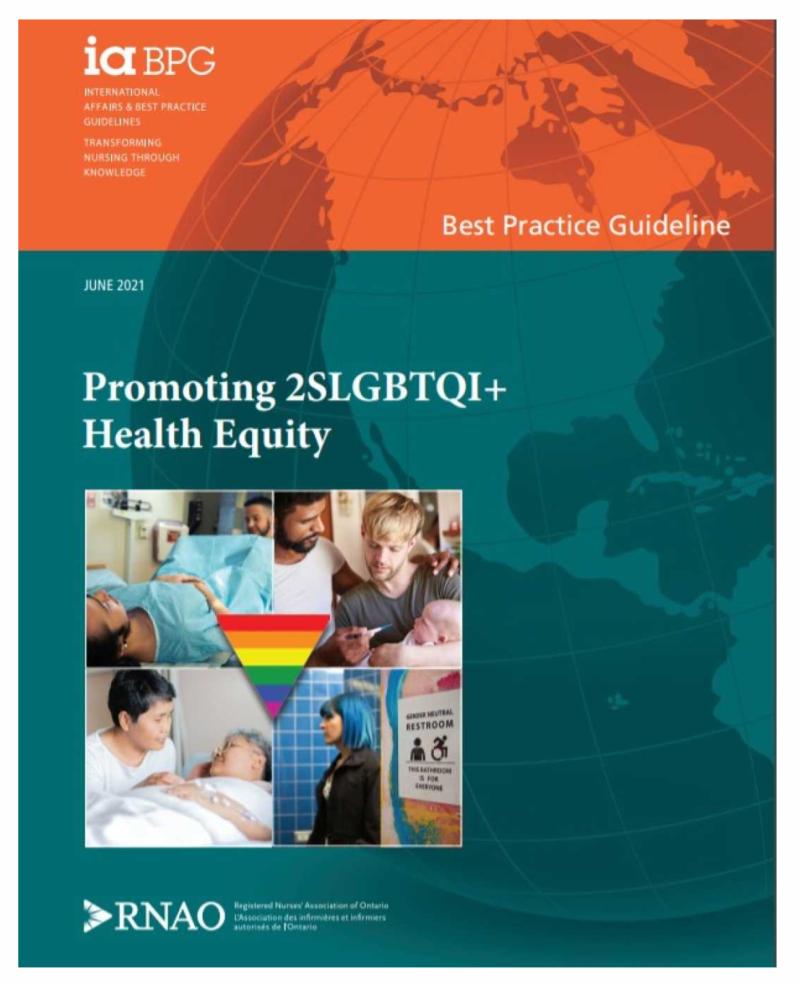
Promoting 2SLGBTQI+ Health Equity
This new best practice guideline (BPG) is titled Promoting 2SLGBTQI+ Health Equity. The purpose of this BPG is to provide nurses and other members of the interprofessional team with evidence-based recommendations on foundational, inclusive and affirming care practices for Two-Spirit, lesbian, gay, bisexual, trans, queer, intersex, and additional (2SLGBTQI+) people. This BPG is also to be used to enhance the safety of health-service organizations, schools and academic organizations for 2SLGBTQI+ communities through the adoption of evidence-based practices. Safe and inclusive environments enable nurses and other members of the interprofessional team to improve access and optimize health outcomes for those receiving care.
The BPG focuses on providing inclusive care across the lifespan and across the continuum of health settings (acute care, long-term care, primary care and public health including school settings). This BPG provides recommendations to promote 2SLGBTQI+ health equity including inclusive communication, safer spaces, risk screening and assessment, group-based interventions and education.